
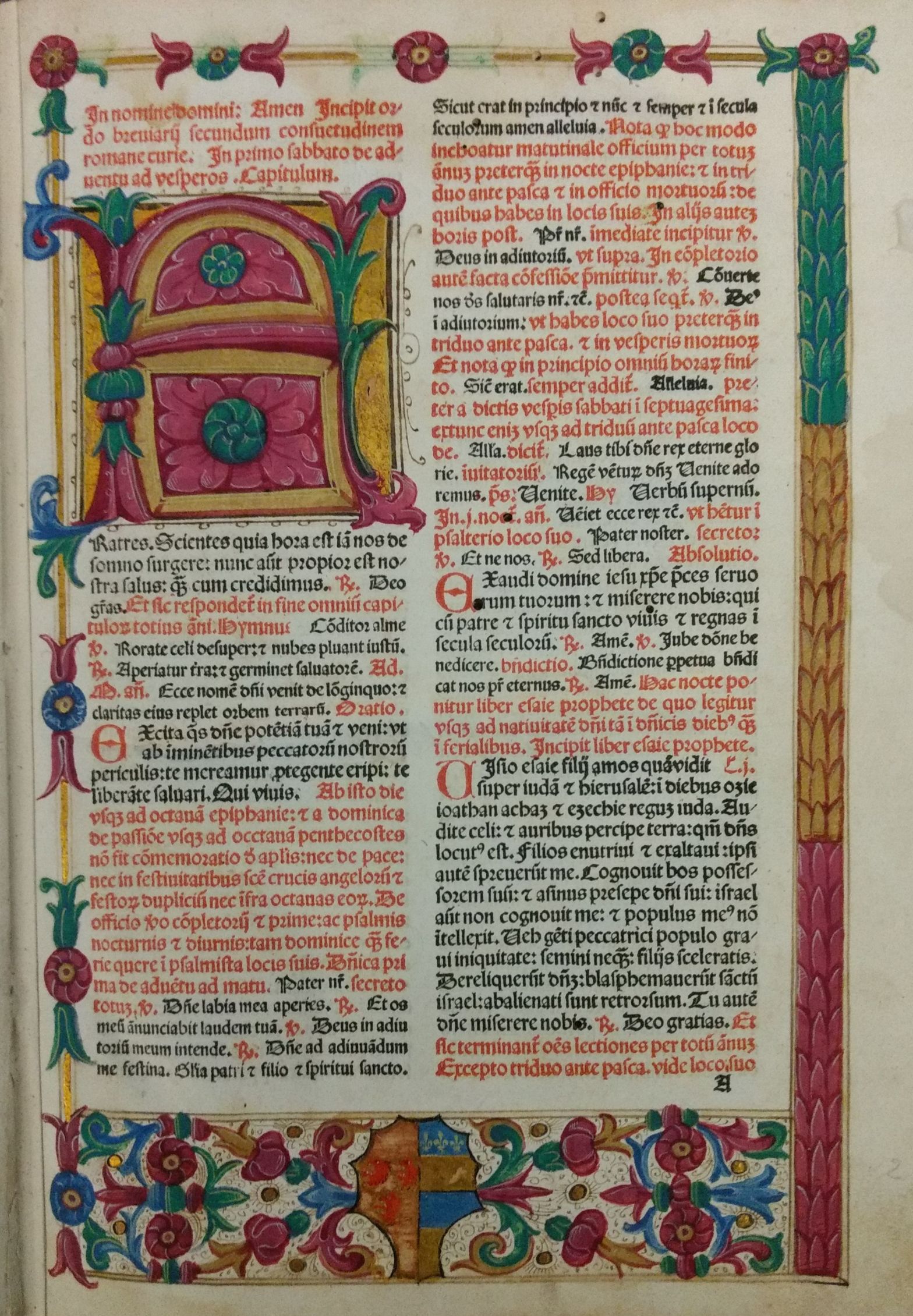
Lord, open my lips,
+ and my mouth shall declare Your praise (Psalm 51:5).
These words, taken from the Book of Psalms, open the Invitatory, the traditional beginning to the Canonical Hours. These Hours are a traditional set of prayers that have defined the Church’s devotional life for two thousand years, forming a precious piece of Christian piety that is unfortunately not as familiar to Christians today as its long history suggests. It is known by many different names: the Divine Office, the Work of God, the Liturgy of the Hours, the Daily Office, the Divine Services; whatever the title, these prayers have been central to Christian liturgy for nearly the entirety of Church history. While commonly associated with monastic life, the Hours have also been practiced by lay Christians across traditions. Orthodox and Catholic communities preserve forms of these prayers, while Anglicans, Lutherans, and Presbyterians have developed their own adaptations for daily devotion.
The scriptural and traditional basis for this practice is profound. The traditional division of the day into seven Hours reflects the 119th Psalm, stating “seven times a day I praise you because your judgements are righteous,” (Psalm 119:164 NABRE). Further, the Jews in the Second Temple period had their own set of daily prayers at fixed times that would have played an important part in their lives (Penner, 2012). In fact, the Book of the Acts of the Apostles records Sts. Peter and John the Evangelist performing their afternoon prayers in the Second Temple (Acts 3:1). Early in Christian history, these prayers were adapted to Christian life, with St. Clement of Alexandria noting early on that Christians had a practice of morning and evening prayer, with a few intermediate Hours of prayer as well (Stromata, Book VII, Chapter 7). Shortly thereafter, the Desert Fathers had a practice of praying the psalmody with resolute constancy. Inspired by this early witness, the Church has ever since then promulgated the participation of her flock in these prayers.
Nevertheless, many Christians never hear about the treasure trove of spirituality contained within the Hours. Despite having been raised in the Catholic Church, where the Hours are required for all priests and consecrated members of religious orders, I was never exposed to this form of prayer as a child. It was only after my freshman year of college when I visited a Franciscan friary in Northeast Philadelphia that I was able to observe how these prayers were lived by the friars. I saw the way that they would begin every day in communal recitation of the psalms, heard how they would slowly and reverently pray in unison. I took note of how every psalm would be followed with the same doxology, spoken at the same pace; how they would hang on every word: “Glory to the Father, and to the Son, and to the Holy Spirit,” accompanied by a profound bow. I listened to the way they would sing the hymns together, and the way they would flip through their worn breviaries, the books containing the Hours, to the correct prayers with a precision only learned after years of sustained practice. In short, I was enchanted.
Over the next few months, as I began to incorporate this form of prayer more and more into my life, I saw the richness of these prayers: I began to notice the way that the liturgical calendar and the Hours would mirror one another, how the Friday psalms would speak of death and despair, but those on Sunday would proclaim joy and redemption. These prayers would anchor my life in the life of Christ, and would remind me every day of His passion and His resurrection. Further, having a set of prayers to recite at the time of waking and sleeping would serve to place the rest of my life in the context of prayer; every day that I prayed the Hours would begin with the word Lord and end with the word amen, and would be sustained throughout by the psalmody.
With that in mind, I think it would be worthwhile to give the reader a brief introduction to the format of the prayer if they are interested in investigating further. That the prayers will look slightly different for different traditions, and if the reader is interested it would benefit them to look into the particulars of their community’s common prayer. That being said, there are traditionally seven canonical hours of prayer, prayed at intervals of roughly 3 hours. The matins are a set of readings from the scriptures and early Christian tradition traditionally prayed in the middle of the night or early in the morning, the lauds are prayed shortly after waking up, and the vespers are prayed in the early evening, these last two primarily consisting of recitation of the psalms, along with short scripture readings. These three are known as the major hours. The others are considered minor hours, and are typically shorter, consisting mainly of psalm recitation: prime (prayed around 6 a.m.), terce (9 a.m.), sext (noon), none (3 p.m.), and compline (9 p.m., or shortly before sleeping). Praying every Hour is a large time commitment, especially when chanted in the traditional fashion (it is the full-time ministry of cloistered monks and nuns, after all), but laypeople can incorporate part of the Hours into their daily life in whatever way fits their schedule. It is most common to pray the matins and lauds shortly after waking up and vespers sometime in the evening while skipping the minor hours, but different configurations may work better depending on individual schedules.
Ultimately, the goal of the Hours is to conform one’s daily life to a rhythm of prayer and recognize the Divine Mysteries into every aspect of daily living, fulfilling Sacred Scripture’s admonition to pray without ceasing. This rhythm, similar to the practice of daily prayer common in the time of the Holy Patriarchs, allows a Christian to share in monastic devotion, imitate the life and prayer ritual practiced by Christ and the Holy Apostles, and scaffold their life in the engagement of constant, common prayer. I would encourage the reader to investigate the Canonical Hours within their tradition and discover the richness of beauty and devotion present within it.
Glory to the Father, and to the Son, and to the Holy Spirit.
As it was in the beginning, is now, and will be forever. Amen.
Works Cited
Clement of Alexandria, Stromata, c. AD 200.
New American Bible, Revised Edition. Confraternity of Christian Doctrine, 2011.
Penner, Jeremy. Patterns of Daily Prayer in Second Temple Period Judaism, Brill, 2012.
Image credit: Klaus Graf – Own work, Public Domain, https://commons.wikimedia.org/w/index.php?curid=63656674

