
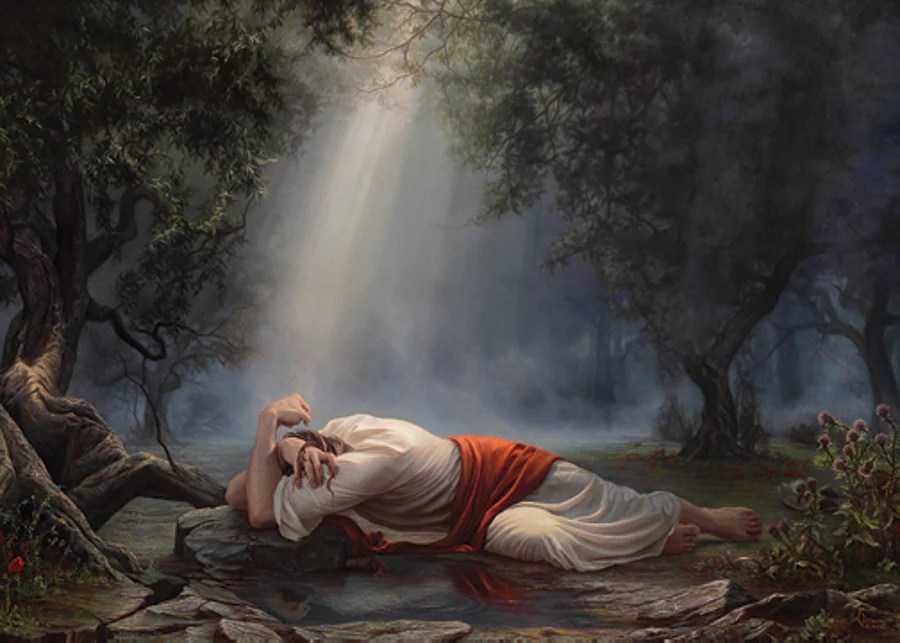
The Garden of Gethsemane is one of the most intimate pictures of Christ’s perfected humanity throughout the gospels. The night Jesus was betrayed, he came to the Garden of Gethsemane to pray with his disciples. I focus on how Jesus is both entirely human and perfect at Gethsemane, setting an example for how we are called to live.
Seeing what was ahead, Matthew mentions that Jesus was “sorrowful, even to death” (14:34) while Luke adds that he was sweating “blood” (22:44, ESV). These details point to the extreme distress that Christ was in. Telling the disciples to keep watch a little farther back, “he fell on his face and prayed, saying ‘My Father, if it be possible, let this cup pass from me, nevertheless, not as I will, but as you will'” (Matt 26:39). The humanity of Christ is almost palpable in this prayer. Extreme distress, the fear of death and coming tribulation, and pleading with God are all hallmarks of living a human life of suffering in a fallen world. Being fully human, Christ suffered it as we do. However, Christ’s perfected humanity enables him to say “not as I will, but as you will.”
Christ is able to completely surrender to the Father, and not rebel in his suffering, to not deviate from God’s will when it is painful. Through this perfect submission, Christ represents a perfected human, perfect in his obedience to God while living in human suffering.
This perfected humanity is painfully contrasted by the disciples. Returning from his fervent prayer, he finds the disciples asleep. He wakes Peter and says, “Could you not watch with me one hour? Watch and pray that you may not enter into temptation. The spirit indeed is willing, but the flesh is weak” (Matt, 26:40-41). Jesus goes again to pray, and again he returns to find the disciples asleep. A third time he goes and a third time they have fallen asleep. This is the image of our broken humanity. The disciples did not mean to fall asleep, they had willingly come to be with Christ. Yet, when God incarnate asks them to stay awake, they could not obey. Tiredness overtook them, the needs of the flesh bore them down, and they fell asleep. Their broken flesh and humanity is reflected in us all. Even when we are willing to obey God, our weakness causes us to fail, revealing that we are too weak on our own to fully obey.
Finally, Jesus told the disciples to ”Watch and pray that you may not enter into temptation.” This is important because Christ was “tempted as we are, yet without sin.” (Hebrews 4:15). If this is truly so, then Christ, the perfected human, was tempted to flee from the cross, to reject God’s plan, and to save himself in that garden. We must ask why Jesus came to Gethsemane to pray? Perhaps he was doing the very thing he taught his disciples to do, to pray so as not to enter into temptation. For if Christ was tempted, then his perfect humanity wasn’t simply a state of holiness, but a daily being of holiness, of choosing God each day. The prayer Christ prayed in Gethsemane was his victory over the flesh and part of his perfected humanity, doing what his disciples could not.
In the Garden of Gethsemane, we see Christ’s perfect humanity: fully human, tempted and suffering like us, yet perfectly obedient to God. By becoming like us, he showed us how to live as perfected humanity. He calls us to be “little Christs,” becoming more like him. As we approach Good Friday, remember that he took on our brokenness so that we might share in his perfection.
This post was written by Christopher Suh, a freshman at the University of Pennsylvania studying Philosophy, Politics, and Economics.
 Penn Epistle