
Part I: The Jewish Passover
When reading Scripture, if not read in the context of the Old Testament from a Jewish standpoint, one is not able to fully understand what and why Christ says what He says and does what He does. Christ reveals Himself to the Jewish people as God, not by explicitly telling them, but by communicating to them in a way that they alone could understand. Therefore, in order for us to understand why the Eucharist is necessary for salvation, we must see how the Jewish people interpreted and understood the words that Jesus spoke. And to do that, we must go back to the beginning: the Jewish Passover of the Exodus.
The central moment of Israel’s history was the Exodus: God’s deliverance of His people from bondage in Egypt through Moses. Every common well-read Jew understood and lived under the expectation that God would one day send a new Moses (the Messiah) who would bring about a new Exodus. Moses himself predicted this: “The LORD your God will raise up for you a prophet like me from among you, from your fellow Israelites. You must listen to him. For this is what you asked of the LORD your God at Horeb on the day of the assembly when you said, ‘Let us not hear the voice of the LORD our God nor see this great fire anymore, or we will die.’” (Deuteronomy 18:15-18).
As a Second Moses leading a New Exodus the expectation was that there also would be a second giving of the Law. A New Law and New Covenant. Moreover, this New Law would be written on hearts rather than on tablets of stone: “‘…I will make a new covenant with the people of Israel and with the people of Judah. It will not be like the covenant I made with their ancestors when I took them by the hand to lead them out of Egypt, because they broke my covenant, though I was a husband to them,’ declares the LORD. ‘This is the covenant I will make with the people of Israel after that time,’ declares the LORD. ‘I will put my law in their minds and write it in their hearts. I will be their God, and they will be my people.’” (Jeremiah 31:31-33).
At the first Passover God gave Israel clear instructions: a male lamb without defect was to be sacrificed (Exodus 12:3-6 ). Its blood must be placed on the doorposts as a sign of salvation (v. 7) and (critically) the flesh of the lamb had to be eaten (vv. 8,9). The sacrifice was not complete simply with the lamb’s death; Israel’s firstborn would be spared only if the lamb was consumed. In this way, the Passover became the pattern of salvation: deliverance through blood and life through eating the lamb.
Jesus, the true Messiah, fulfills this pattern. He is the new Moses who inaugurates the new Exodus, delivering humanity from sin as Paul tells us, “Get rid of the old yeast, so that you may be a new unleavened batch—as you really are. For Christ, our Passover lamb, has been sacrificed. Therefore let us keep the Festival, not with the old bread leavened with malice and wickedness, but with the unleavened bread of sincerity and truth.” (1 Corinthians 5:7-8).
Israel’s journey ended when Joshua (whose name in Hebrew is the same as “Jesus”) led the twelve tribes across the Jordan into the promised land, as the waters parted once again (Joshua 3:16), recalling the Red Sea. This moment prefigures Christ’s baptism in the Jordan, where the heavens, not earthly waters, were parted (Mark 1:10) to deliver us to a new Promised Land (not earthly but Heavenly). Just as Joshua brought twelve tribes into the land, Jesus called twelve apostles to restore the people of God and fed them with miraculous bread in the wilderness (Mark 6:41–44, the feeding of the 5,000), signaling the new Exodus had begun.
Given that this was the new Exodus and a new Passover was going to be instituted, it follows that God would command this new Passover to be kept and remembered as He did in the old covenant. The Torah instructs, “‘You shall tell your son on that day, ‘It is because of what the Lord did for me when I came out of Egypt.’” (Exodus 13:8). This idea of personal participation is reinforced in the Mishnah, “In each and every generation a person must view himself as though he personally left Egypt” (Mishnah Pesahim 10). The Catechism of the Catholic Church emphasizes this as it describes the Eucharist as, “The memorial of the Lord’s Passion and Resurrection: The Holy Sacrifice, because it makes present the one sacrifice of Christ the Savior” (CCC 1330). This instruction is again seen at the Last Supper, when Jesus transforms the Passover meal. “This is my body… This cup is the new covenant in my blood… Do this in remembrance of me” (Luke 22:19–20). Therefore, when we partake of the Eucharist we are present in the sacrifice of Christ, with the apostles, and we consume His true and divine body. Apostle Paul later adds “Is not the cup of thanksgiving for which we give thanks a participation in the blood of Christ? And is not the bread that we break a participation in the body of Christ?” (1 Corinthians 10:16).
But how could Christ command His disciples to “pour out” blood, when the Torah forbade the drinking of blood (Leviticus 17:14)? Well in the old covenant, only priests poured out sacrificial blood upon the altar (Leviticus 4:7). At the Last Supper, Jesus institutes a new priesthood, Himself as High Priest with the Twelve as ministers, through whom His blood is poured out for the forgiveness of sins.
This leads to a decisive truth: just as the first Passover was not complete until the lamb was eaten, so the new Passover is not complete until the true Lamb is consumed. A mere symbol cannot suffice; one must truly partake of a real lamb, real flesh, the Lamb of God. To receive the Eucharist is to let God “pass over” us in the new covenant, sparing us from eternal death. God declared this in the old Passover and He does so again in the new: “Jesus said to them ‘Very truly I tell you, unless you eat the flesh of the Son of Man and drink His blood, you have no life in you’” (John 6:53).
Thus, the Eucharist is not optional—it is necessary for salvation. In it, the new Exodus is fulfilled, the new covenant sealed, and the faithful are fed with the true bread of life.
Part II: The Manna
Once freed, the Israelites became hungry and complained. In the desert, hunger and thirst pressed upon them, and the people began to grumble: “‘If only we had died by the Lord’s hand in Egypt! There we sat around pots of meat and ate all the food we wanted, but you have brought us out into this desert to starve’” (Exodus 16:2–3). This mirrors the temptation we all face in conversion: to look back longingly on our former lives of sin rather than endure the desert trials of discipleship.
God responded by sending bread from heaven (manna) in the morning, and flesh in the evening (Exodus 16:8). Scripture describes the manna as a white, mysterious substance, tasting “like wafers made with honey” (Exodus 16:31). The sweetness of honey pointed forward to the promised land “flowing with milk and honey.” Thus manna was not only daily nourishment but also a pledge, a foretaste of the inheritance to come.
The Israelites knew this bread was no ordinary food. Psalm 78 calls it “grain from heaven” and that “man ate the bread of angels” (vv. 23–25). Its very name in Hebrew—man hu, means “What is it?” which captures the mystery. Was it natural or supernatural? Ordinary or extraordinary? Earthly or heavenly? A question that echoes through the ages and still does, even today.
Manna was not merely consumed and forgotten; it was preserved as sacred. God commanded a portion to be placed in the Tabernacle “to be kept for the generations to come” (Exodus 16:33). Later, the author of Hebrews reminds us that the Ark of the Covenant contained “the golden jar of manna” (Hebrews 9:3–4). This signaled to Israel that manna was more than sustenance, it was covenantal food, linked to God’s dwelling among His people.
Jewish expectation grew to believe that in the time of the Messiah, this heavenly bread would return. The apocalyptic Jewish text 2 Baruch records:
And it will happen that when all that which should come to pass in these parts has been accomplished, the Anointed One will begin to be revealed…
And those who are hungry will enjoy themselves and they will, moreover, see marvels every day.…
And it will happen at that time that the treasury of manna will come down again from on high, and they will eat of it in those years because these are they who will have arrived at the consummation of time (2 Baruch 29:3,6,8).
In other words, the coming of the Anointed One would be marked by the return of manna from heaven.
This hope illuminates the Our Father. In the petition “Give us this day our daily bread,” the Greek word translated as “daily” is epiousios—a word unique in all of ancient Greek literature, found only in the Lord’s Prayer (Matthew 6:11). Scholars note that its root parts mean “above” (epi) and “substance” (ousia), yielding a literal sense of “super-substantial bread.” (The process in which the bread becomes the Body of Christ upon the words of consecration is transubstantiation). The Catechism confirms this: “Taken literally (epiousios) refers directly to the Bread of Life, the Body of Christ” (CCC 2837). Thus Jesus Himself teaches us to pray not merely for earthly food, but for the new manna: His own Eucharistic presence which we partake in every day at Mass; our everyday miracle.
Jesus explicitly identifies Himself as this bread from heaven in John 6: “‘For the bread of God is the bread that comes down from heaven and gives life to the world (v.33)…I am the bread of life (v.35)…Your ancestors ate the manna in the wilderness, yet they died. But here is the bread that comes down from heaven, which anyone may eat and not die (v.49-50)…I am the living bread that came down from heaven. Whoever eats this bread will live forever. This bread is my flesh, which I will give for the life of the world’” (v.51).
The crowd balked at His words: “‘How can this man give us his flesh to eat?’” (v. 52). But instead of softening His teaching, Jesus doubled down: “‘Very truly I tell you, unless you eat the flesh of the Son of Man and drink His blood, you have no life in you’” (v. 53). In Greek, Jesus shifts from the general word “eat” (phago) to the more graphic trogo—“gnaw” or “chew”—making His meaning unmistakably literal. “For my flesh is food indeed and my blood is drink indeed.” (v. 55). Many found this to be “a hard teaching” (v. 60) and walked away (v. 66). Yet Jesus did not call them back to clarify it was a metaphor or a way of speaking, as He did with Nicodemus when speaking about baptism —a very important matter that leads to salvation.
The manna of the wilderness prefigures the Eucharist. If the first was miraculous bread from heaven, the new manna cannot be reduced to a mere symbol. To suggest so would make the old covenant manna greater than the new covenant Eucharist. But in Christ, the new always surpasses the old. So at the very least, the Eucharist must still be super-substantial bread from Heaven (not merely ordinary bread) and nothing less. The Eucharist is thus not only the crucified flesh of the Lamb but also His risen and glorified body, given for the life of the world. This is why Jesus adds, “‘Does this offend you? Then what if you see the Son of Man ascend to where He was before?’” (John 6:61–62). The Eucharist is resurrection food: participation in His glorified flesh.
For the apostles, for Paul, for Mary, for the earliest Jewish Christians, the Eucharist was immediately recognized as the new manna, the true bread of angels, the fulfillment of the promise. At every Mass, the treasury of manna indeed comes down from heaven, and we who believe see marvels every day.
Thus, the Eucharist is necessary for salvation not only as the new Passover Lamb but also as the new manna from heaven: the true bread that sustains us in the desert of this life and pledges our entrance into the eternal Promised Land.
Part III: Bread of the Presence
When God delivered Israel from Egypt, He not only gave them the Law but also immediately taught them how He desired to be worshiped. After the Ten Commandments (Exodus 20), God revealed to Moses the plans for the Tabernacle, His dwelling among the people (Exodus 25). Within this sacred tent were placed three signs of God’s presence: the Ark of the Covenant, the golden lampstand (the menorah), and the golden table for the Bread of the Presence.
Each of these three held deep symbolism. The Ark, hidden and unseen, reflected the invisible God the Father. The menorah, with seven tongues of fire, reflected the Spirit (Recall Pentecost in Acts and the tongues of fire). The golden table with its perpetual bread and wine pointed to the Son. Already, in shadow and type, the Trinity was hidden in the sanctuary of Israel.
Leviticus 24 describes the Bread of the Presence (lehem ha-panim) in detail. Twelve unleavened loaves, representing the twelve tribes of Israel, were placed on the golden table each Sabbath. This bread was called an “everlasting covenant” and was always to remain before the Lord. Alongside it, the menorah was to be kept burning continually. In the Catholic Church today, we still see its fulfillment: the sanctuary lamp burning beside the Tabernacle where the true Bread of the Presence—Christ Himself—dwells.
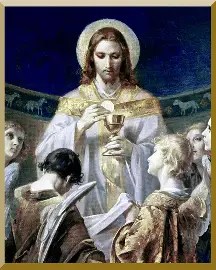
When the bread was removed, it was veiled, emphasizing its sacredness. At the Temple, according to rabbinic tradition preserved in the Talmud (Babylonian Talmud, Menahoth 29a), the priests would lift up the golden table of the Bread of the Presence at Passover and declare to the people: “Behold God’s love for you.” Something that Jesus himself would have practiced, as this was Jewish tradition kept per God’s commands. How striking is it that in every Mass the priest lifts up the Eucharist making the same declaration. Even more, the Bread of the Presence was not only bread, it was joined with wine offerings (Exodus 25). Bread and wine together were set before God in the sanctuary. This double sacrifice foreshadows the bread and wine that Christ transforms into His Body and Blood at the Last Supper, fulfilling the eternal covenant.
The Hebrew word panim is rich in meaning: it can mean both “presence” and “face.” Thus, the Bread of the Presence could also be called “the Bread of the Face”—a visible sign of the very face of God. Rabbis spoke of it as the bread through which God allowed His people to behold Him. In Christ, this mystery becomes literal: in the Eucharist we encounter not only God’s presence but His very face, hidden under the sacramental veil.
Jesus Himself refers to the Bread of the Presence:
At that time Jesus went through the grainfields on the Sabbath. His disciples were hungry and began to pick some heads of grain and eat them. When the Pharisees saw this, they said to him, ‘Look! Your disciples are doing what is unlawful on the Sabbath.’ He answered, ‘Haven’t you read what David did when he and his companions were hungry? He entered the house of God, and he and his companions ate the bread of the presence—which was not lawful for them to do, but only for the priests. Or haven’t you read in the Law that the priests on Sabbath duty in the temple desecrate the Sabbath and yet are innocent? I tell you that something greater than the temple is here. (Matthew 12:1–6)
What could be greater than the Temple of God on earth? Only God in the flesh. In this bold claim, Jesus identifies Himself as the true Temple, His disciples as the new priesthood, and His Body as the new Bread of the Presence.
John 2 confirms this: “Destroy this temple, and in three days I will raise it up” (v. 19). The evangelist explains that He was speaking of the temple of His body. In the Eucharist, this temple is made present across the world. No longer confined to Jerusalem, Christ’s Body can be with His people in every parish, in every land, until the end of the age.
The logic of Israel’s worship leads naturally to the Christian conviction of the Real Presence. If the Old Covenant bread was the “bread of the face of God,” veiled, perpetual, and holy, how much more must the New Covenant Bread be? If Israel saw a shadow of God’s love in the golden table, how much more do we see God’s love in the Host lifted high?
Thus, the Eucharist fulfills and perfects the Bread of the Presence. It is not merely a symbol but the true Body of Christ: As the new Passover, it is the lamb we must eat to be saved (Exodus 12; John 6:53). As the new manna, it is the bread from heaven that sustains us in the desert until we reach the promised land and grants eternal life (John 6:49–51). And as the new Bread of the Presence, it is the perpetual sign of God’s covenant, His very face hidden yet real, His love lifted up for us to behold.
What a miracle it is that the Bread of the Presence is here with us now. We are still in the desert; that is the point. If He abides in the Tabernacle, then we remain the wilderness generation, not yet in the Promised Land but still on the journey. And every day, through the Eucharist, He assures us: “I am with you. Trust Me. I will bring you home.”
One day, when the New Exodus is complete and we cross into the true Promised Land, the manna of this pilgrimage will cease, just like it did when the Israelites reached the Promised Land. In that heavenly inheritance, He will no longer be hidden under the veil of bread and wine. As St. Paul says, “we now see through a mirror dimly,” but then we shall see Him as He is, no longer veiled, but face to face (1 Corinthians 13:12) .
 Penn Epistle