
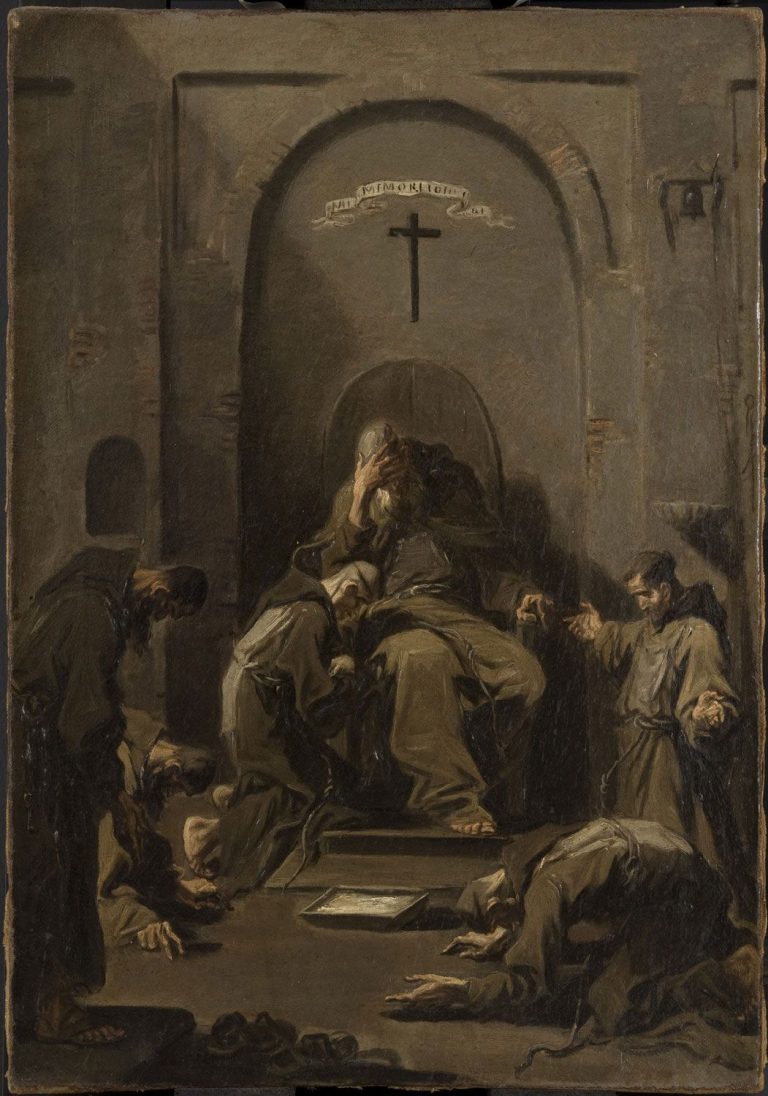
“And I will turn your feasts into mourning, and all your songs into lamentation: and I will bring up sackcloth upon every back of yours, and baldness upon every head: and I will make it as the mourning of an only son, and the latter end thereof as a bitter day.” (Amos 8:10).
“Therefore we instruct the friars, who have chosen to be abject in the house of God, to dress in the poorest, roughest, most abject, austere and worthless cloth readily found in the provinces where they are. Let the friars remember that the sackcloth in which Saint Francis wanted them to be patched and the cords we gird ourselves with should not suit the rich of the world.” (Congregatióe, ch. 2).
A warm light breaks over the horizon. In a dimly lit and sparsely outfitted workshop, tucked away from the eyes of the world, a man is at work. His hands gently lay out the coarse fabric with great reverence, treasuring the silence of the morning and the soft shuffle of the sackcloth. He marks, he cuts, and he sews with motion as deliberate as it is firm; each seam is a hymn, and each stitch a prayer. He is a lesser brother, an heir of Saint Francis. Out of an inexpensive wool, unfit for worldly clothes, he is fashioning something that goes beyond the world; something that beckons all who see it to humble and contrite prayer, a piece of clothing that calls the one who wears it to the narrow way of sanctification. In this simple workshop, a man is doing the work of God.
Saint Francis of Assisi was a man utterly enthralled with the Divine. He was raised in 13th century Italy, where war and poverty were commonplace and little care was given to those in need. He became wrapped up in this culture when he was young (Di Celano, bk. 1 ch. I), but had a severe existential crisis that caused him to reevaluate his entire approach to life. He spent his days in deep, mystical prayer and wished more than anything for God to grant him a path. These petitions were answered one day when he was praying in a chapel of mossy, decaying stone where he heard a voice call out to him: “Francis, go and repair My Church.” Initially taking this literally, he spent the next several years rebuilding the church he prayed in, stooped in the dust, piling stones until the ruin sang once again with prayer (Di Celano, bk. 1 ch. II-VIII). After these years of holy work, he realized that God’s command for him went beyond the simple restoration of decaying buildings; God willed for him to lead a rejuvenation, a reorientation of the Christian people towards the glory of the divine mysteries and away from the distractions of the world (Di Celano, bk. 1 ch. IX).
This realization led to him dedicating his life to preaching to the people of Italy and calling them to repentance. He renounced all of his possessions and began to wander the countryside, proclaiming the glory and redemptive power of Christ (Matthew 3:1-6). Eventually, he gained a small band of followers (Di Celano, bk. 1 ch. X) who dedicated themselves to the service of the poor, the sick, and the hungry, to deep, contemplative prayer, and to a life dedicated to the sacred vows of poverty (Matthew 19:21), chastity (Matthew 9:12), and obedience (Luke 22:42). These men became the Friars Minor, or “Lesser Brothers,” and the Order that they founded has persisted to this day.
The spirituality of these brothers is unique and ancient, combining a deep love for the natural world, a mystical prayer life, service to those most in need, and a strict dedication to the vows, most of all to holy poverty. The early Franciscans were dedicated absolutely to the Gospel, accepting sacred poverty and joyful communal life as few religious orders had previously, in strict imitation of the holy Apostles (Acts 4:32). They renounced all of their possessions and gave bread to the hungry, shelter to the stranger, and consolation to the sick (Matthew 25:35-36); in this poverty, they gained for themselves the riches of heaven, having all sweetness within them (Psalms 119:103). They understood that the bread of charity is life itself for the poor (Ecclesiasticus 34:25), but also that not in bread alone does man live (Deuteronomy 8:3), and so they created a community of active-contemplatives, where prayer was central to the service of others, and where the service of others became a form of prayer. This spirituality is manifested and displayed to the world in the habit of these Lesser Brothers, the robes that act as their uniform and monastic cell.
One of the most potent examples of the spiritual significance of this habit is in Brother Cypriano da Genova, an Italian friar from the 16th century. It was said that he was a man of deep contemplation (Da Pobladura, 181), who, in keeping with the counsel of the Sacred Scriptures, prayed without ceasing (1 Thessalonians 5:17) and became a new creation in Christ (2 Corinthians 5:17). He was a novice in the newly created Order of Friars Minor Capuchin, a religious community that began as a reform of the Franciscan brotherhood with the intention of taking the Order back to its practice during the days of St. Francis of Assisi and his early companions.
Brother Cypriano, like many saints and doctors before him, was rejected by many in his time (Luke 6:22, John 15:18). It was said that the Capuchin friars believed him to be too outspoken, in a manner unbefitting of a lesser brother. They decided that he would not move past his novitiate, and would have to leave the Franciscan life and return to the world. They sent him to retrieve the secular clothes he had left behind upon entering his novitiate.
It took time for him to truly internalize what this meant for his life, but when he did he felt great distress. One can imagine the young Brother Cypriano, looking at the clothing he had left behind and realizing that he would have to give up his habit. His holy habit: the symbol of his calling and life, the inheritance of the lesser brothers, a rag completely useless to the world to which the friars devoted themselves completely. It was said that shortly after this, before he had fully left the Order, he fell deeply ill. Laying on his cot, fever burning his body, he rejoiced in his illness because he thought it may allow him to die without renouncing his habit. Not two weeks later, he passed away in this same habit, singing songs of praise to God that the other friars could not understand.
What is in this habit, that it makes a man delight in his own death?
Brother Cypriano’s devotion to the habit has deep roots in the Franciscan tradition. This habit is a fixture in not only the spiritual life of Brother Cypriano, but also of the myriad friars who have accepted it throughout the ages. The habit has its beginnings with the renewed spiritual life of St. Francis. It is said that when Francis decided to renounce all for Christ, he began to wear a one-piece peasant’s tunic made of undyed wool, the mantle of our brothers the sheep, and girded himself with a simple rope of three knots, one for each of the monastic vows, fashioned of a coarse fiber; fruit of the earth and work of human hands. He walked barefoot wherever he went, even in the coldest winters, feeling in his feet the warm embrace of his sister Mother Earth with each step. This habit was a sign of the rejection of the world and of individualism (Matthew 16:24) and was a constant reminder to the friars of their vows, and in particular their dedication to holy poverty. This habit, when laid out, took the form of a cross, such that each friar would carry with him wherever he went a deep and significant remembrance of the sacrifice made once for all (Hebrews 7:27). This habit served as a reminder of the suffering Christ, the weeping Christ, the Christ born in a manger who by His passion and cross has us all free. It was this Christ who dined with sinners and tax collectors (Matthew 9:10) and made those suffering in the world turn to the words of the holy prophet Isaiah to proclaim that God is with us (Isaiah 7:14).
The holy institution of the habit of the Lesser Brothers has touched the lives of countless friars, but more importantly it has touched the lives of the poor and downtrodden that they encounter in their daily ministry. Upon fully meditating on this institution, one can almost feel the great joy of the early Capuchin Brother Pietro da Todi as recorded in the annals of the Capuchin Order when he received this sign of pure poverty:
“Pietro da Todi took the holy habit of Saint Francis with such great fervour that for many days he was not able to stop himself from weeping for joy,” (Da Pobladura, 178).
With this in mind, we return to the humble friar in his workshop, slowly sewing this symbol of the Holy Gospel into one piece. As he sews, he daydreams of all of the things that are to come from it: the confessions heard while it is being worn, the food stains that it will receive at communal meals and soup kitchens, the dirt and earth that will graft onto it along the way. As the sun grows higher in the sky, he puts the final touches in and lifts up his handiwork, a robe with neither wrinkle nor stain. He stops for a moment, he looks down on his own patched habit and back up again, and he softly smiles.
Lord Jesus Christ, grant us the humility of the Lesser Brothers who accepted their sackcloth of mourning in the imitation of Your cross and who sing of the coming day when our brothers the mountains will drip with sweetness:
“Behold the days come, saith the Lord, when the ploughman shall overtake the reaper, and the treader of grapes him that soweth seed: and the mountains shall drop sweetness, and every hill shall be tilled.” (Amos 9:13).
–
Da Pobladura, Melchiorre, OFMCap (trans. Hanbridge, Paul, OFMCap). The Capuchin Reform: A Franciscan Renaissance. 2007.
Di Celano, Tommaso. The Life of Saint Francis. 1229.
Douay-Rheims Bible. 1752.
Order of Friars Minor, Capuchin. Congregatióe (Capuchin Constitutions). 1536.
 Penn Epistle